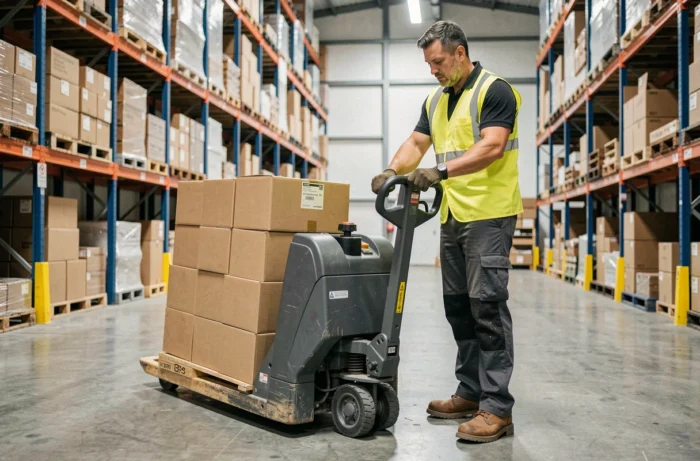
Article R.4541-3 of the Labor Code imposes a clear hierarchy: eliminate manual handling through mechanical or organizational means before training on movements and postures. This legal obligation directly guides the choice of equipment towards solutions that eliminate load carrying, not just those that accompany it.
Repositionable mobile equipment: an underutilized lever for heavy loads
Most industrial sites still think in terms of fixed infrastructures: overhead cranes, ground-anchored conveyors, sealed gantries. These installations cover a defined perimeter and freeze the organization of the workshop.
Repositionable mobile devices change the game. No ground anchoring or civil engineering work is required, making them compatible with rented premises, workshops undergoing frequent reconfiguration, or SMEs that do not have the budget for an overhead crane.
Among these pieces of equipment are removable lifting gantries, mobile gantries on weighted bases, and lift tables on braked wheels. Their load capacity reaches levels compatible with the majority of machined parts or mechanical sub-assemblies handled in production.
We recommend checking the compatibility between the maximum useful load, lifting height, and the nature of the ground (strength, flatness) before any deployment. Specialized catalogs like the one available on transtec.fr allow for comparison of these parameters across a wide range of transfer and handling equipment.
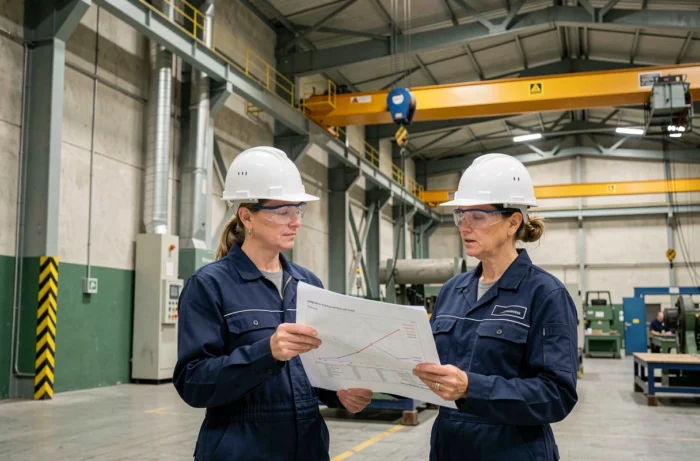
The benefits are not limited to ergonomics. A repositionable piece of equipment follows the production flow rather than constraining it. When a workshop shifts from long runs to short batches with different stations, the equipment migrates with the workload.
Autonomous mobile robots and hybrid handling in logistics
Automating the transfer of heavy loads does not necessarily require complete robotization. Autonomous mobile robots (AMR) handle the internal movement of pallets between storage areas and workstations, but the operator remains responsible for the initial pickup of the load.
This hybrid operation presents a concrete advantage: it reduces the distances traveled by operators without requiring a complete overhaul of the process. The AMR navigates independently using onboard sensors and adapts to changes in the environment (moved pallets, congested aisles).
We observe that this gradual approach is particularly suitable for companies looking to reduce pedestrian traffic in warehouses without investing in a fixed conveyor system. Integration occurs in stages, starting with one or two robots, then scaling up based on measured results in cycle times and reduced movements.
- The AMR manages horizontal transport over medium to long distances, including between connected ground-level buildings.
- Coupling with a lift table or a manipulator arm at the start and end points eliminates manual lifting.
- Dynamic mapping allows for route modifications without heavy reprogramming, unlike automated guided vehicles (AGV) that follow rails or magnetic strips.
Exoskeletons for load transfer: field feedback and limitations
Exoskeletons are not just professional show gadgets. At Lemaitre Sécurité, a robotic and connected exoskeleton is used daily by an employee responsible for unloading trucks. The device assists with the effort at the moment of picking up and carrying the load, where lumbar strain is at its maximum.
This feedback shows that the exoskeleton finds its place in highly repetitive tasks with limited movement amplitude. Truck unloading fits this profile exactly: the same action repeated over several hours, significant unit load, restricted workspace.
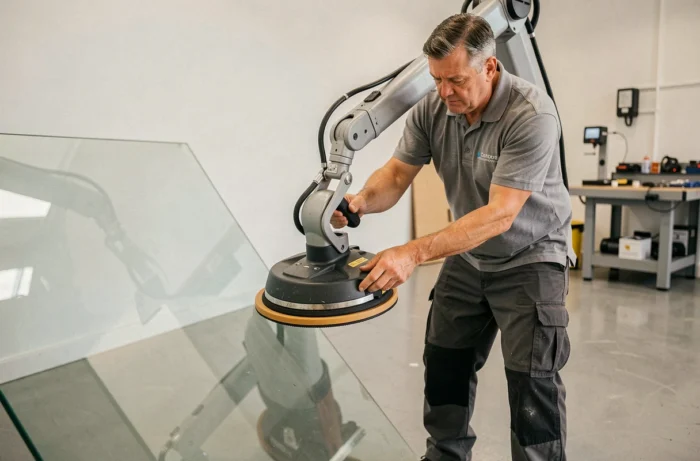
However, limitations quickly appear in versatile positions. An operator alternating between lifting, walking, climbing stairs, and working on the ground will find the exoskeleton cumbersome. The fit between the position and the device takes precedence over the intrinsic performance of the equipment.
- Assess the variability of movements in the position before testing an exoskeleton: the more standardized the movement, the more measurable the benefit.
- Plan for an acclimatization period of several weeks, during which productivity may decrease before recovering.
- Involve the biomedical service or occupational physician from the selection phase to objectively assess gains on joint strain.
Safety and reduction of MSDs: structuring the approach before purchasing
Acquiring lifting or transfer equipment without mapping physical flows amounts to treating a symptom. The approach to preventing musculoskeletal disorders requires analyzing at-risk positions, quantifying the tonnage handled per operator and per shift, and identifying load peaks.
The elimination of manual carrying must precede any training actions. This is the logic of article R.4541-3: the employer first seeks a mechanical or organizational solution. Training on movements and postures only comes into play when the residual risk cannot be eliminated otherwise.
In practical terms, this means that an investment in a motorized tug or a self-propelled cart is more easily justified in front of labor inspection than a simple annual training session. The single document for assessing professional risks must reflect this prioritization.
A well-thought-out transfer of heavy loads combines appropriate equipment, flow organization, and monitoring of accident indicators. Solutions exist, from the simplest (mobile gantry, lift table) to the most advanced (AMR, exoskeleton). The choice is made position by position, always starting from the actual physical constraint measured on the ground.