
Choosing a training program in illustration is not just about comparing lists of schools. The real challenge lies upstream: understanding what skills each curriculum develops, what career opportunities it truly opens up, and how it prepares for a rapidly evolving market. A future illustrator should ask these questions even before putting together an application file.
What generative AI changes in the choice of an illustration school
Since the gradual implementation of the European AI Act in February 2025, mastery of artificial intelligence is no longer a bonus on an illustrator’s CV. It has become an expected skill, including on a regulatory level.
In practical terms, organizations must now train their teams in the use of AI and adhere to rules for tracking generated images. For a student entering training today, this means that a school that does not address AI at all, the issue of prompt engineering, or acceptable uses will be out of sync with professional reality upon graduation.
Before applying, check if the program includes a module dedicated to these topics. A training program that integrates AI as a tool and as an ethical subject prepares students better than one that ignores it or simply prohibits it. The nuance matters: it is not about replacing drawing with automatic generation, but about understanding how these tools fit into a visual production chain.
To navigate among the many illustration schools, this technological criterion deserves to be placed on the same level as the quality of the teaching staff or the reputation of the diploma.
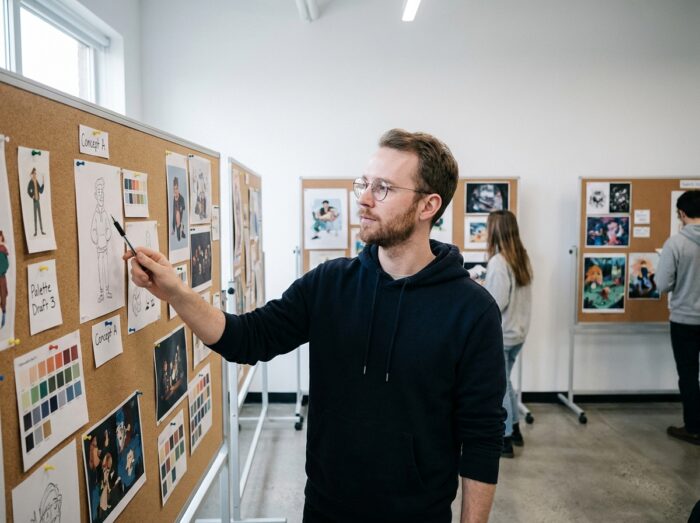
Hybrid profiles and real opportunities after art school
The classic job description presents the illustrator as a freelancer working for the press, children’s publishing, or advertising. This portrait remains valid, but it only reflects part of the current market.
Schools that publish their employment data show a marked diversification of opportunities. Among the jobs accessible after a curriculum focused on illustration, we now find:
- Motion design, which involves animating illustrations for the web, social media, or video, a sector in high demand.
- UX/UI design, where the ability to visually think through a user journey directly aligns with the skills of a digitally trained illustrator.
- Brand content and art direction, which mobilize a personal graphic universe in service of a brand.
- AI design and prompt engineering, emerging roles that require both a solid visual culture and a technical understanding of generative tools.
A curriculum that only trains in editorial illustration limits the range of possibilities. During open houses or admission interviews, ask the question directly: what jobs are held by graduates from the last three classes?
The importance of the portfolio in selection
Public schools like the Beaux-Arts or Arts Déco require a strong portfolio upon admission. They expect an already structured artistic project, not just a collection of drawings.
Private schools sometimes offer a preparatory year (often called “prepa arts appliqués”) that allows students to build this portfolio. The prep year is not a detour; it is an investment for candidates who have not yet defined their graphic identity.
Employment rates and certification: the data to request before enrolling
Comparing art schools based solely on their reputation leads to approximate choices. A more reliable indicator exists: the professional insertion rate six months after graduation. Some schools publish it, others do not. Its absence should raise questions.
Two distinct data points deserve your attention:
- The certification success rate (which measures how many students obtain the diploma).
- The actual employment rate after training (which measures how many work in their field, as employees or freelancers).
These two figures do not say the same thing. A school may display a high certification rate while having a low employment rate, revealing a gap between the educational content and market expectations.
Request this data during open house days. If the school cannot provide it, that is information in itself. Programs registered with the RNCP (National Directory of Professional Certifications) are required to produce it, which serves as a guarantee of transparency.

Workshop, workspace, and student life in art school
One often overlooked point in comparisons: access to workshops and creative spaces. In illustration, workshop work remains central, even for students aiming for digital. Drawing among other artists, receiving direct feedback on an ongoing project, sharing specialized materials—all of this shapes progress.
Some schools offer open workshops outside of class hours, while others limit access to specific slots. This difference impacts the work rhythm and the ability to develop personal projects alongside the curriculum.
The geographical context also matters
A school located in a city with an active cultural fabric (galleries, illustration festivals, artist residencies) offers networking opportunities that the program alone does not guarantee. Meetings with active artists, collective exhibitions organized by the school, and partnerships with local publishers or studios provide a concrete extension of the training.
Choosing an illustration school involves several years of work and investment. Rather than relying on rankings or brochures, visit the workshops, ask former students, and compare employment data. These concrete elements allow you to distinguish a training program suited to your project from one that is not.