An artwork can disappear from the walls of a museum by the force of a judgment, only to find its place in the public domain under different conditions. A creator, recognized in a discipline, sometimes reinvents themselves in territories where the codes are eroding, never renouncing their legitimacy. Artistic interventions, long silenced, suddenly find themselves projected to the center of global exchanges for their political or social significance.
No trajectory moves in a straight line. Institutional decisions, market demands, the shifting expectations of the public: all of this constantly makes and unmakes the status and perception of contemporary art.
When contemporary art becomes narrative: major milestones and new challenges
Contemporary art continually redefines its contours, shifting its markers. Each work, each approach, rewrites a history in motion. Pioneers like Ernst Gombrich or Daniel Arasse paved the way for a research that rejects fixed narratives and prefers complexity. Where Giorgio Vasari outlined the genealogy of the Renaissance in the 16th century, current artists seize legacies, break codes, and play with rupture as well as continuity. The written history of art is invented in this constant back-and-forth between foundational texts and field experiments.
The perspective evolves, driven by voices that shift the gaze. Walter Benjamin points out the aura, that irreplaceable something that technical reproduction disrupts. Roland Barthes, by dissecting photography, opens another path toward reading images. Paul Ardenne, when he examines art in the face of the Anthropocene, pushes the reflection to the most pressing ecological and social issues. The boundaries become porous between human sciences and artistic practices, between analysis and creation.
Let’s take the journey of Esmeralda de Vasconcelos. Her work, presented in Esmeralda de Vasconcelos: an artistic journey between cultural recognition and contemporary creation (Bohème Magazine), embodies this intersection between institutional recognition and exploration of the contemporary. At each stage, creation relies on analysis, engages in dialogue with history, and is nourished by the social context. The field of art redraws itself, moving from Dijon to Paris, from Europe to alternative scenes, from the academic sphere to experimentation.
The method is no longer fixed: it oscillates between the iconology conceived by Erwin Panofsky, the pragmatics of John Dewey, or the rhetoric advocated by Jacqueline Lichtenstein. Contemporary creation asserts itself as a narrative, an experience, a constantly renewed tension between text, image, and society.
Artists, museums, and society: what trajectories for today’s creators?
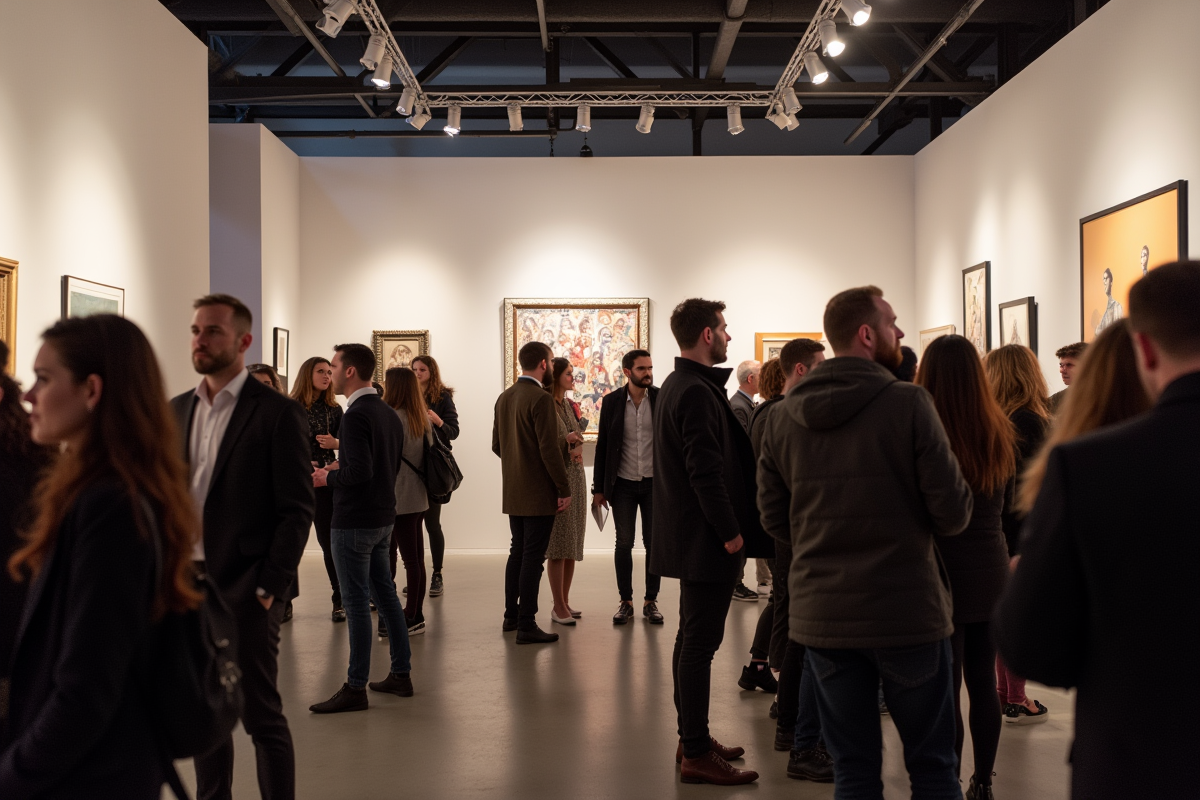
The contemporary artist does not settle for a closed space; they traverse cities, cross institutional boundaries, and immerse themselves in social realities. Paris, London, Dijon: each place imposes its rules, networks, and modes of recognition. The figure of the artist breaks free from old categories to embrace hybrid artistic practices, blending performance, installation, digital art, and sculpture. Curators orchestrate this dialogue between creators, inventing unprecedented ways to present the work and connect it to society.
Linda Nochlin marked a turning point by questioning the place of women in the history of art, paving the way for feminist art history and queer, post-colonial perspectives. The museum, long perceived as a sanctuary, now participates in the social debate: it exhibits, contextualizes, and interrogates. Projects are built on shared research, collaborations, and unexpected encounters with diverse audiences.
Here are some examples that illustrate these major evolutions in the artistic field:
- Eadweard Muybridge’s or Étienne-Jules Marey’s chronophotography inspired the Italian futurism, from Giacomo Balla’s Dynamism of a Dog on a Leash to Umberto Boccioni’s Unique Forms of Continuity in Space.
- François Cheng, with his reflection on “Void,” renewed the approach to painting, challenging the Western view of composition.
Between museums, interventions outside the walls, and emerging scenes, the artistic field is transforming. Today’s artists invent unprecedented forms, reinterpret materials, and push the boundaries of creative gestures. Their journeys, marked by detours and ruptures, reveal, over time, these friction points where art questions society, and sometimes, shakes it up.