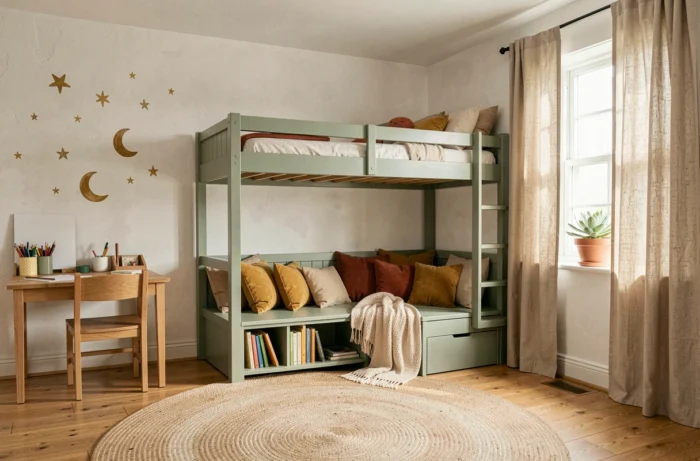
Arranging a child’s room is about solving an equation between what they like and what keeps them safe. Before choosing a wall color or a unique bed, several technical constraints need to be considered. These factors are crucial to the success of the project, far more than the choice of a decorative theme.
Air quality and paint: what matters before decorating
Have you ever noticed the lingering smell after repainting a room? These are volatile organic compounds (VOCs) released into the indoor air. In a child’s room, this exposure is amplified by the time spent in the room, often more than ten hours a night.
Since 2013, construction and decoration products sold in France carry a regulatory label for indoor air emissions, rated from A+ to C. For a child’s room, always prioritize paints rated A+.
Choosing the right paint is not enough. Timing is just as important: painting well in advance of the child’s arrival and airing out the room thoroughly after application significantly reduces exposure to residual VOCs. Paint applied the day before moving in, even if rated A+, will not have had enough time to dry and off-gas properly.
New furniture also contributes to the VOC load in the room. Particle boards, mattress foams, and synthetic textiles emit their own compounds. Unpacking and airing out new furniture several days before installation limits this phenomenon. If you are buying furniture for your child’s room, specialized retailers offer ranges designed for the youngest: https://www.le-petit-castor.fr/ notably features furniture suitable for children’s rooms.
Wall mounting and furniture safety in a child’s room
Decor competitors talk about shelves, dressers, and storage without addressing the issue of tipping. Yet, this is a documented risk, especially when the child begins to climb or open multiple drawers simultaneously.
Every piece of furniture accessible to the child must be secured to the wall. Wardrobes, dressers, low bookshelves: stabilization is not optional; it is a prerequisite for any arrangement. Anti-tipping kits provided with some furniture do not replace proper anchoring suited to the type of wall (drywall, brick, concrete).
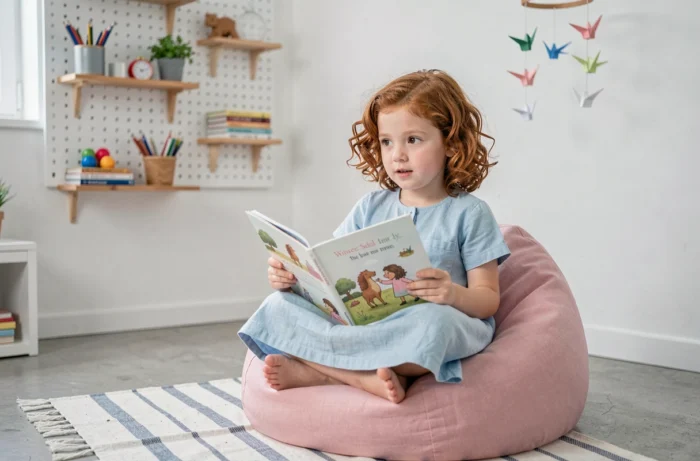
Also consider decorative shelves. A wall shelf loaded with books or toys must support the actual weight of the stored items, not just the empty weight indicated on the packaging. Check the maximum load and the recommended type of mounting.
Organizing areas to limit risks
Instead of scattering furniture, group heavy storage against a load-bearing wall. The play area should remain clear on the floor. This zoning (sleep, play, storage) is not just a decorative trick: it reduces interactions between the moving child and unstable furniture.
Loft or bunk bed: checks before purchase
The loft bed is appealing because it frees up floor space. In a small room, this is a strong argument. However, it imposes age and compliance constraints that inspirational articles rarely mention.
The DGCCRF recommends not using a loft bed for a child under 6 years old. This threshold is not arbitrary: before this age, motor skills and awareness of danger during sleep are not sufficiently developed.
- Ensure the bed complies with NF EN 747 or NF D 62 100 standards, mentioned on the label or the manufacturer’s instructions.
- Safety barriers must be present along the entire length of the bed, with a limited opening for access to the ladder.
- The distance between the bed and the adjacent wall must not create a space where the child could get stuck.
- The stability of the structure must be tested: a bed that moves with the slightest motion indicates insufficient assembly or an unsuitable model.
If your child is under 6 years old and you lack space, a low convertible bed with integrated storage offers comparable space-saving without the risks associated with height.

Colors and wall decoration: creating a universe without overloading the room
Once safety issues are addressed, decorating becomes a true pleasure. The choice of colors has a direct impact on the room’s atmosphere and indirectly on sleep.
Soft shades (sage green, grayish blue, powder pink) calm the space without darkening it. An accent wall in a brighter color or with patterned wallpaper is enough to give character to the room. Limiting strong color to one wall avoids visual saturation.
Personalizing without drilling everywhere
Wall stickers allow for creating a thematic universe that the child can evolve as they grow. They can be removed without damaging the paint, making them an ideal option for rentals.
Framing your child’s drawings and hanging them on a taut wire or magnetic strip transforms the wall into an evolving gallery. The child participates in decorating their space, which enhances their sense of ownership.
For visible storage, fabric or wicker baskets on low shelves add texture without weighing down the room. They also allow the child to tidy up independently, which structures daily autonomy.
Lighting and ambiance for the child’s sleep
Lighting is often the last aspect addressed in a child’s room project. This is a mistake. Poorly thought-out lighting disrupts falling asleep just as much as a poor choice of bedding.
Plan for at least two light sources: a ceiling light or pendant for general lighting, and a bedside lamp or nightlight for the transition to sleep. Warm light bulbs (orange hue) promote melatonin production.
Avoid placing a screen in the room. The blue light it emits delays falling asleep, and its presence transforms the resting space into a stimulating one. The room benefits from remaining a place dedicated to sleep, reading, and quiet play.
Arranging a child’s room that truly works starts with making the right technical choices (indoor air, fixings, bed compliance), then allowing creativity to express itself within this secure framework. The colors, the drawings hung on the wall, and well-chosen furniture will do the rest.