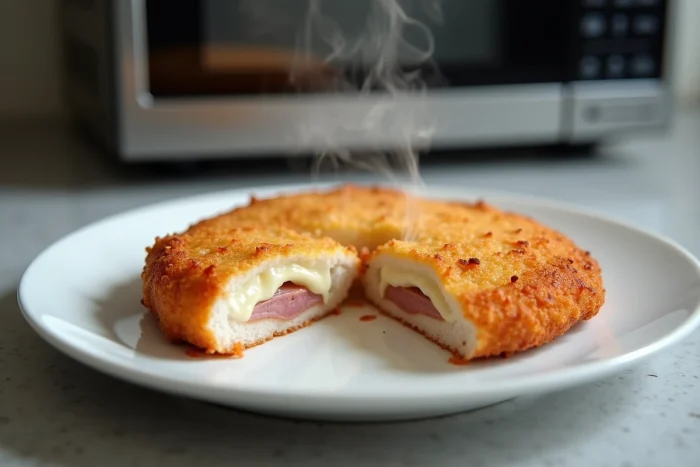
The breaded cordon bleu, whether fresh or frozen, presents a specific technical problem in the microwave: heat does not distribute evenly within the food. The waves penetrate unevenly into a thick product stuffed with ham and cheese, creating cold spots at the core while the coating softens on the surface. The issue is therefore not only taste-related, but also concerns food safety, particularly for frozen poultry products.
Power and cooking time for cordon bleu in the microwave: comparative table
The time required to cook a cordon bleu in the microwave depends on two variables: the power of the device and the state of the product (fresh, refrigerated, or frozen). Industrial packaging rarely indicates a precise operating method for the microwave, and some brands even state “Do not microwave” on their frozen cordon bleus.
The table below summarizes the cooking parameters suitable for each situation.
| State of the cordon bleu | Recommended power | Indicative time (1 piece) | Pause and turning |
|---|---|---|---|
| Fresh or refrigerated | 750-800 W | 2 to 3 minutes | Turn halfway through cooking |
| Frozen (without defrosting) | 600 W then 800 W | 3 to 5 minutes (in stages) | Mandatory pause, turn |
| Frozen (defrosted in the refrigerator) | 750-800 W | 2 to 3 minutes | Turn halfway through cooking |
For a frozen cordon bleu cooked directly, proceeding in two stages of power reduces the risk of cold spots. Starting at medium power allows the core to defrost before increasing the power to finish cooking.
Several practical guides detail the method to cook a cordon bleu in the microwave by adjusting these parameters according to the device used.
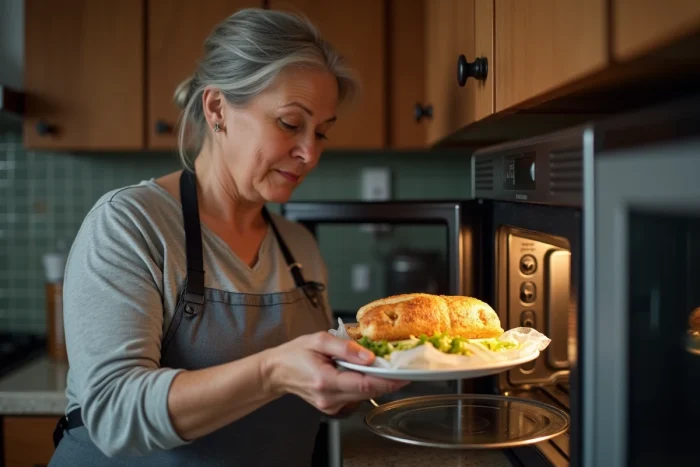
Cold spots and food safety: what ANSES reports on breaded poultry
ANSES has reminded that frozen breaded poultry products, including cordon bleus, must reach a sufficient core temperature to destroy Campylobacter and Salmonella. Quick cooking in the microwave is among the preparation methods most at risk for cold spots, according to an opinion published in 2018 on food exposure to Campylobacter bacteria.
The microwave heats by agitating water molecules. In a cordon bleu, the dry coating absorbs little energy, while the melting cheese and ham, which contain different amounts of water, heat at variable speeds. The result: the cheese can be burning while the center of the meat remains lukewarm.
Some precautions can reduce this risk:
- Let the cordon bleu rest in the closed microwave for one minute after cooking, so that the heat redistributes by conduction
- Check the temperature at the center of the meat with a kitchen thermometer if you regularly cook frozen breaded products
- Cut the cordon bleu in half before serving to visually check that the meat is no longer pink at the core
The EFSA/CDC report on zoonoses in Europe documented the strengthening of labeling by several industrial brands, with stricter cooking instructions by type of device. If your packaging explicitly states not to use the microwave, this mention has a direct health reason.
Crispy coating in the microwave: why the texture changes and how to limit damage
The breadcrumbs of a cordon bleu become crispy in the oven or in a pan thanks to the Maillard reaction, which requires dry and high heat on the surface. The microwave does not produce this type of heat. The steam generated by the water in the product softens the coating instead of browning it.
The texture obtained will always be inferior to that of cooking in the oven or in a pan. However, a few adjustments can limit the loss of crispiness:
- Place the cordon bleu on a paper towel in the plate to absorb excess moisture during cooking
- Use a microwave-safe dish with an elevated grid, if your device has one, to prevent the bottom from soaking in condensation
- Pass the cordon bleu under the grill of the oven for one to two minutes after microwaving, to re-crisp the surface (this step transforms the result)
- Avoid covering the dish with film or a lid, which traps steam and guarantees a soft coating
The paper towel under the cordon bleu makes the biggest difference in terms of final texture. This simple tip absorbs the steam that accumulates between the coating and the dish.
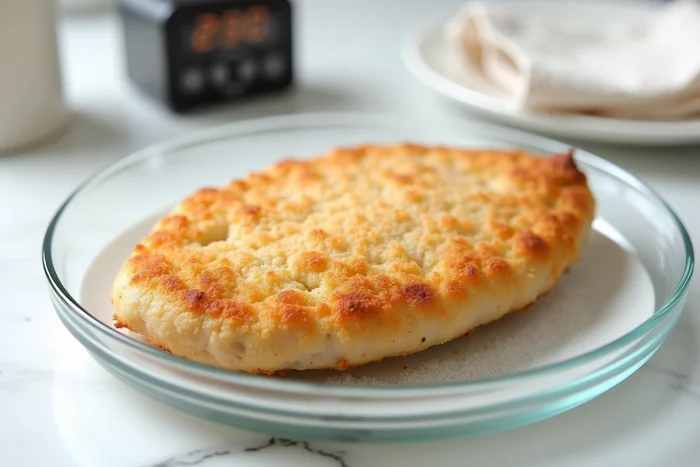
Homemade or industrial frozen cordon bleu: the microwave does not treat them the same way
A homemade cordon bleu prepared with fresh cutlets, ham, and cheese like comté or gruyère has an advantage in the microwave: its thickness and composition are controlled. A thin and even cutlet cooks more uniformly than an industrial product whose shape and density vary from piece to piece.
In contrast, an industrial frozen cordon bleu often contains additives, added water, and a thicker coating. The amount of water in the industrial product amplifies the problem of softening of the breadcrumbs in the microwave. The cheese used (often a melting cheese preparation rather than aged cheese) liquefies quickly and can escape from the coating if the cooking is too aggressive.
For a homemade cordon bleu, microwaving at medium power for a few minutes gives an acceptable result, especially if finishing is done in a pan with a drizzle of oil for thirty seconds on each side. For a frozen product, the staged power method remains the most reliable.
The microwave remains a stopgap tool for the cordon bleu, not an optimal cooking method. The pan and oven produce a golden coating and melting cheese without the risk of cold spots. When time is short, the combination of microwave then grill or quick pan offers the best compromise between speed and quality of the result.