
The consumer hardware and software market is undergoing a rapid restructuring phase. Between AI chips embedded in laptops, mixed reality headsets repositioned for productivity, and AI agents taking control of our smartphones, the lines are shifting on multiple fronts simultaneously. Here’s an overview of the high-tech trends currently reshaping the geek landscape.
NPU and AI PC: when the dedicated AI processor settles into laptops
The “AI PC” category has emerged as a central focus of announcements from Intel, AMD, Qualcomm, and Microsoft since the keynotes at CES 2024 and Build 2024. The principle relies on integrating a NPU (Neural Processing Unit) directly onto the chip, alongside the traditional CPU and GPU. This component handles AI tasks locally, without relying on the cloud.
Microsoft formalized this direction with its “Copilot+ PC,” machines where AI functions (meeting summaries, photo editing, real-time translation) run directly on the terminal itself. The concrete benefits: reduced latency, data that remains on the machine, and preserved battery life since the NPU consumes less than a GPU tasked with the same calculations.
For tech enthusiasts wanting to explore the-infos-du-geek.fr and its news, this shift towards local AI deserves attention. It changes the usual criteria for choosing a laptop: the raw power of the processor matters less than the NPU’s ability to manage embedded language or vision models.
Field feedback varies on this point. Some users report significant gains in creative workflows (assisted video editing, real-time background removal). Others believe that optimized software for NPU is still too few to justify the extra cost at purchase. The maturity of the software ecosystem will be the true arbiter.
Spatial computing and mixed reality headsets: beyond VR gaming
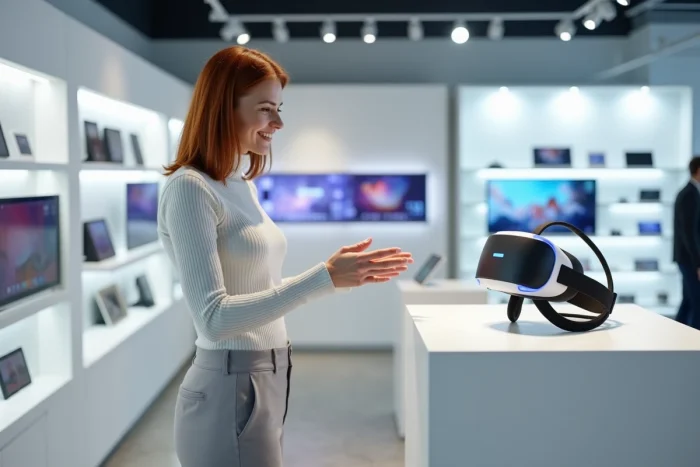
Virtual reality has long been associated with video games. Since the launch of Vision Pro by Apple and the successive repositioning by Meta, the discourse has shifted towards “spatial computing,” a term that encompasses productivity, 3D collaboration, and the display of virtual screens in space.
Apple has introduced work-oriented updates to visionOS: floating windows, compatibility with macOS apps, screen sharing in immersive videoconferencing. Meta, for its part, is pushing the Quest towards professional uses with modeling and training applications. Lenovo is also exploring this niche.
The headset becomes an augmented workstation, not just an entertainment accessory. This is a paradigm shift for geek culture: VR/AR hardware is moving out of the gaming lounge and into the office.
The current limits of spatial computing
The weight of headsets, visual fatigue after prolonged use, and cost remain documented barriers. The available data does not yet allow for conclusions about massive adoption in professional contexts. Initial feedback points to actual use being limited to a few hours per day, far from completely replacing a traditional multi-screen setup.
AI agents on Android smartphones: Gemini Intelligence and advanced voice control
Google has launched Gemini Intelligence, an AI agent capable of directly controlling the functions of an Android smartphone. The idea goes beyond a simple voice assistant: the agent can navigate applications, fill out forms, and execute sequences of actions based on natural language instructions.
For geeks following innovations in artificial intelligence, this type of agent marks a break from single-command assistants. Instead of answering a question, the AI acts within the phone’s interface as a human user would.
- Autonomous navigation through menus and third-party apps, without the developer needing to integrate a specific API
- Chaining complex tasks (booking a restaurant, sending confirmation via message, adding the event to the calendar) from a single sentence
- Partially local operation thanks to Google’s Tensor chips, reducing reliance on the cloud for simple queries
The question of security remains open. An agent that controls the phone’s interface potentially accesses all installed applications. Sandboxing mechanisms and granular permissions will need to evolve at the same pace as these agents’ capabilities.
Connected objects and health wearables: finer sensors, broader data questions
Health wearable technologies continue to progress with increasingly precise sensors. Connected watches and rings now measure estimated blood pressure, continuous blood oxygen levels, and stress indicators based on heart rate variability.
Health gadgets no longer just count steps. They feed personalized dashboards that cross-reference sleep, physical activity, and biomarkers to provide daily recommendations. The AI algorithms embedded in these connected objects detect patterns invisible to the naked eye.
However, this granularity raises questions about the collection and storage of health data. European regulations govern certified medical devices, but the majority of consumer wearables do not fall into this category. Ambiguity persists regarding manufacturers’ use of data, and privacy policies vary widely from one brand to another.
Gaming gadgets: the line between PC and console blurs
On the gaming side, the trend towards portable consoles running Windows (like the Steam Deck and its competitors) blurs the traditional distinction between PC and console. These machines allow for playing a complete PC catalog on the go, with performance improving with each generation.
Sony has also adjusted its prices for the PS5 and PS5 Pro, redefining the value-for-money ratio in the console segment. The choice between gaming laptop and console now depends more on the software catalog than on hardware.
The high-tech landscape of recent months is characterized by convergence: artificial intelligence is infiltrating every layer of hardware, from laptop NPUs to smartphone agents, through wearable algorithms. The criteria for choosing a gadget are no longer limited to raw specs. The quality of AI integration and transparency regarding personal data are becoming as concrete parameters as screen size or battery life.