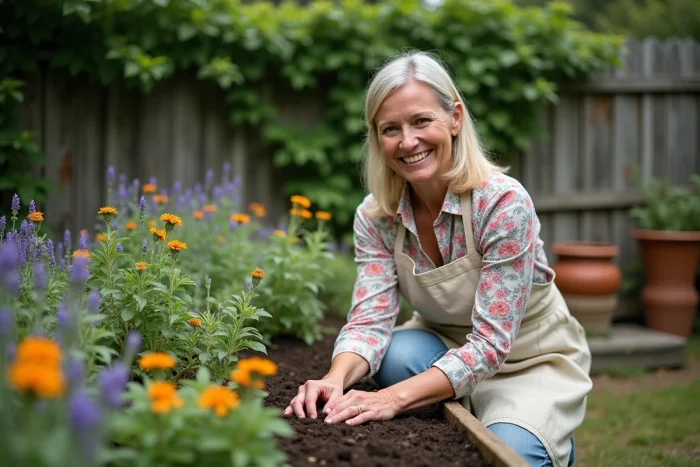
A colorful natural garden all year round without excessive watering: the equation seems simple, but it relies on choices of plants, soil, and structure that deserve comparison. Which perennials offer the best color/maintenance ratio? How to maintain visual interest when flowering stops? These are the two questions this article addresses, supported by data.
Xerophytic perennials vs. classic annuals: the color and maintenance comparison
Drier summers push many gardeners to abandon water-hungry annual beds. The specialized press of 2023-2024 highlights drought-resistant perennials (gaura, echinacea, lavender, euphorbias, sedums) capable of blooming from May to autumn with very little watering.
The table below compares the two approaches based on the criteria that matter for a vibrant and colorful natural garden.
| Criterion | Classic annuals (petunias, impatiens, begonias) | Xerophytic perennials (gaura, echinacea, lavender, sedums) |
|---|---|---|
| Watering | Frequent, sometimes daily in summer | Very low after planting |
| Duration of flowering | Long (May-October), but replanting every year | Long (May-autumn), spontaneous return each season |
| Color palette | Wide, bright and uniform tones | Wide, more nuanced tones, varied textures |
| Wildlife support | Limited (often double flowers, low in nectar) | High (simple flowers, rich in nectar and pollen) |
| Annual maintenance | Planting, uprooting, soil replacement | End-of-winter pruning, division every 3-4 years |
| Cost over 5 years | High (replacement every spring) | Low (initial investment, then almost nothing) |
On almost all criteria, xerophytic perennials win for a natural garden. The only real advantage of annuals is the uniformity of color, useful for a temporary visual effect, but incompatible with a living ecosystem.
You can find all the information on L’Esprit Nature to delve deeper into choosing plants suitable for this type of garden.
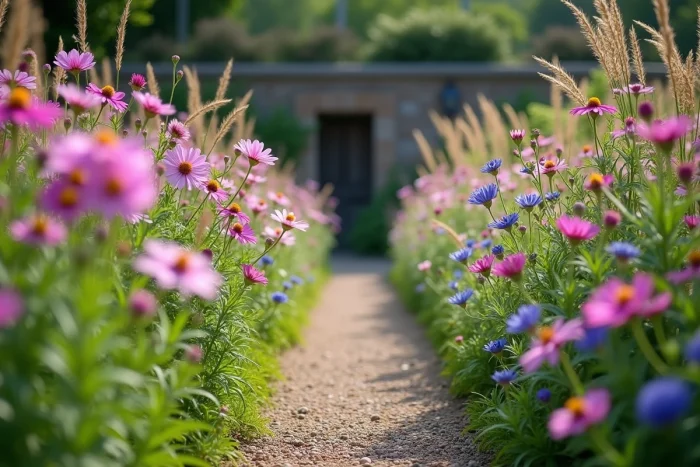
Flowering meadows in a bag: why results often disappoint
The “flowering meadow” seed mixes sold in garden centers are appealing due to their promise of spontaneous colors. Recent feedback from gardeners and landscapers nuances this picture. The majority of these mixes mainly contain annuals that disappear after the first season.
The soil plays a crucial role. A flowering meadow sown on rich ground primarily produces grasses that smother the flowers. In contrast, poor and well-drained soil promotes floral diversity, which explains why limestone road edges produce such beautiful natural meadows.
What works better than a bagged seed mix
- Planting perennials in pots (echinacea, yarrow, sages, nepeta) in a prepared bed, for a visible result from the first year and lasting for several seasons
- Combining these perennials with some ornamental grasses (stipa, blue fescue) that provide movement and structure even in winter
- Leaving an un-mowed lawn area at the edge, where local wildflowers can naturally establish themselves, without purchasing seeds
This approach of structured perennial beds costs more upfront but produces a more reliable colorful garden than random sowing.
Colors outside of flowering: foliage and furniture as visual relays
A natural garden often loses its visual appeal between November and March. Landscapers are increasingly working on two levers to maintain color all year round without artificial plants.
Evergreen foliage and colorful bark
Bergenias, for example, provide purple foliage all winter. Evergreen euphorbias maintain a bright chartreuse green. In terms of trees and shrubs, red-stemmed dogwoods (Cornus sanguinea) or yellow (Cornus sericea ‘Flaviramea’) create bright color spots in a dormant garden.
A garden that remains colorful in winter relies on foliage, not flowers. This is a design principle to integrate from the planting stage, reserving at least one-third of the spaces for evergreens and semi-evergreens.
Colorful furniture and structures
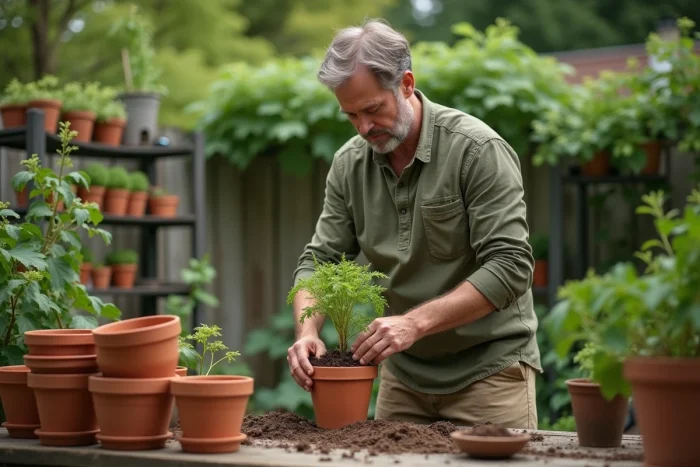
Recent sources of decoration and landscaping show that colorful garden furniture, pottery, and painted screens serve as a reserve of color when flowering ceases. A bright blue bench, an ochre trellis, or glazed terracotta pots structure the view and compensate for the plant dullness.
A gardening expert from Mon Jardin Ma Maison also advises choosing the color of the fence based on the desired depth effect. Dark shades (forest green, anthracite) visually enlarge the space, unlike white, which shrinks the perspective.
Welcoming wildlife: the changes that truly make a difference
Planting nectar-rich flowers is not enough to create a “lively” garden. Wildlife needs nesting sites, water points, and movement corridors.
- A water point, even modest (buried dish, mini pond of a few dozen liters), attracts birds, amphibians, and beneficial insects within weeks
- Dead wood left in a pile in a shady corner serves as shelter for hedgehogs, beetles, and decomposer fungi
- Birdhouses suited to each species (tits, robins, bats) measurably increase animal presence, as shown by the Refuges LPO program
- A free hedge composed of elder, wild rose, and viburnum provides food and shelter across multiple layers of vegetation
These installations require almost no maintenance once established. They transform a decorative garden into a true functional ecosystem.
The choice of plants determines the colors. The choice of structures and micro-habitats determines the life. A successful natural garden combines both from the design stage, rather than adding birdhouses afterward to an already fixed bed. The most telling data remains this: xerophytic perennials cost less, consume less water, and support more pollinators than classic annuals. Starting from this observation simplifies every planting decision.