An apartment with a long-haired dog and old parquet flooring does not pose the same constraints as a tiled studio occupied by a single person. The suction power of a robot vacuum, expressed in pascals (Pa), serves as the first filter for selection, but it only tells part of the story. Understanding what this figure concretely means, and especially what it does not say, helps avoid a disappointing purchase.
Pascals, airflow, and noise: what the technical sheet does not connect
The pressure in pascals measures the force with which the motor creates a vacuum to suck up particles. A robot vacuum rated at a few thousand Pa generates sufficient suction for a clean hard floor. However, on thick carpet or long-haired rugs, a significantly higher suction is needed to extract hair and dust embedded in the fibers.
The problem is that most product sheets isolate pascals from the rest. Yet airflow, expressed in liters per minute, is just as important. A high suction without sufficient airflow poorly sucks up light particles that remain suspended above the floor. This scenario is found in some entry-level models that boast flattering Pa ratings but have anemic airflow.
The other overlooked parameter is noise. ANSES published work in 2022-2023 highlighting that the discomfort related to the noise of household appliances significantly increases beyond a certain threshold, even for short use. Increasing suction power almost always means increasing decibels. An article detailing robot vacuum power on Madmoizl Déco clearly explains this correlation between Pa and daily sound comfort.
Suction power and floor type: adapting the robot to its home
On tile or varnished parquet, most debris remains on the surface. A mid-range robot is sufficient in this context, provided that its side brushes effectively sweep dirt toward the suction mouth.
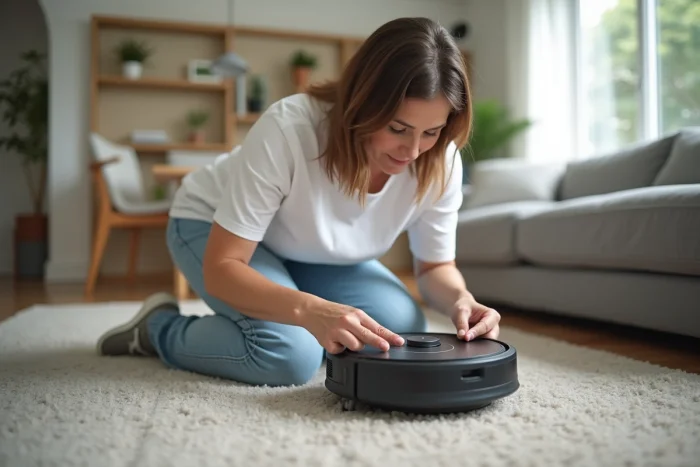
The situation changes radically with carpet or rugs. The fibers trap hair, pet fur, and fine dust deep down. A higher suction is then required, combined with a motorized rotating brush that lifts the fibers to release the particles.
Situations that require more power
- Medium or long-pile carpets, where particles sink beyond the surface and resist a simple pass
- Homes with one or more pets, whose fur quickly clumps in corners and along baseboards
- Rooms exposed to frequent dust influx (ground floor facing a street, garden accessible directly)
A powerful robot on carpets but used only on tile wastes energy and sound comfort. Recent models often offer an automatic mode that adjusts the suction according to the detected surface, which prevents running the motor at full load continuously.
Power loss with a full bin: the trap of tests under ideal conditions
Tests from independent laboratories published since 2024 (Stiftung Warentest in Germany, Which? in the UK) have highlighted a phenomenon that manufacturers rarely mention. Some robots lose a significant portion of their suction capacity when the bin is half or two-thirds full.
In practice, this means that the advertised power corresponds to an empty bin, under optimal testing conditions. Over the course of the cleaning session, performance gradually drops as the tank fills up. Feedback on this point varies by brand, but the pattern is recurrent.
How to limit this degradation
Models equipped with an auto-emptying station partially circumvent the problem. The robot returns to empty its bin into a larger reservoir before resuming its cycle, which maintains more consistent suction throughout the cleaning duration.
Manually emptying the bin before each session remains the simplest solution for models without a station. It takes a few seconds and prevents starting a cycle with a bin that is already cluttered.
Next-generation motors: more pascals without skyrocketing consumption
Since 2023, motor manufacturers like Nidec have communicated about more efficient mini-turbines capable of achieving higher suction at equal or slightly reduced consumption. This advancement translates into a trend toward increased suction power without a proportional rise in consumption in the 2024-2025 ranges.
For consumers, this changes the game. Recent mid-range robots now reach suction levels that were reserved for high-end models two years ago. Comparing a model released in 2023 with a model from 2025 at an equivalent price often shows a measurable performance leap in Pa, without sacrificing battery life.
Concrete criteria for choosing a robot vacuum based on power
Before settling on a pascal figure, it is beneficial to cross-reference power with the actual context of use:
- Identify the dominant floor type in the home (hard, mixed, or predominantly textile) to calibrate the necessary suction level
- Check the noise level in maximum power mode and compare it to standard mode, as the difference often reaches several decibels
- Look for whether the robot automatically adjusts its power according to the detected surface, which preserves battery life and reduces noise on hard floors
- Prefer a model with an auto-emptying station if the home exceeds a certain size, to avoid performance drops related to bin filling
The best robot vacuum is not the one that displays the most pascals, but the one whose power matches the constraints of the home without generating unnecessary nuisances. A well-calibrated model for a medium-sized tiled apartment will cost less and be quieter than an overpowered robot designed for textile surfaces. Reasoning based on the floor type, acceptable noise, and bin size remains the most reliable method to avoid mistakes.