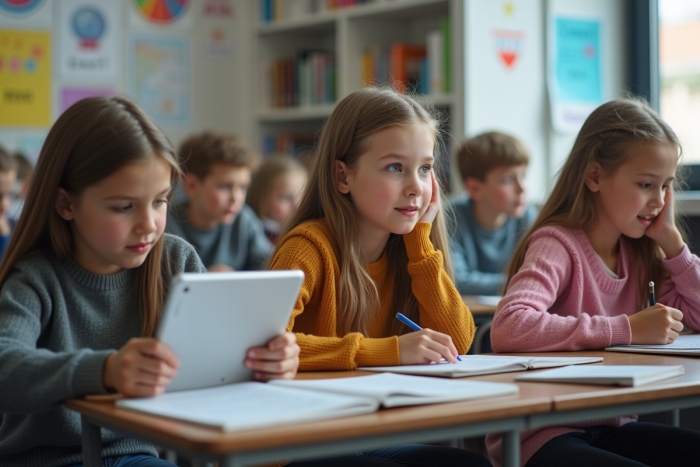
A school textbook no longer guarantees students’ attention. Despite the rise of digital technology, the whiteboard remains omnipresent in classrooms. Teachers juggle various tools, often dictated by institutional constraints, resource availability, or the rapid evolution of technology.
Innovative solutions emerge each year, but their adoption remains uneven, sometimes hindered by a lack of training or equipment. Artificial intelligence is beginning to infiltrate the educational landscape, altering practices and questioning established habits.
Overview of Educational Materials in the Classroom: Between Tradition and Digital Innovation
In the reality of classrooms, a profusion of educational materials shapes the daily lives of teachers and students. Traditional textbooks, long considered essential references, now share the stage with more current tools: digital resources, mind maps, interactive whiteboards. This coexistence reveals the ongoing movement of an educational system striving to integrate the best of each era. The teacher, as a skilled tightrope walker, adjusts their practice according to the needs of the group and the means at their disposal to give meaning to each learning experience.
Digital educational materials are gaining ground and changing the game. Mind mapping software, collaborative work platforms, real-time assessment applications: each solution aims to adapt content, personalize progression, and encourage active student involvement. Online resources, such as this blank world map to print, illustrate this need for flexible, reusable materials that are easy to integrate into differentiated approaches. A printed map can serve as a basis for a collective explanation, support a small group workshop, or accompany a more autonomous student project.
Inclusion occupies a prominent place. Tools must adapt to the particularities of each individual, paying close attention to the principles of inclusive education. While virtual reality and other immersive devices remain scarce, these approaches already open up perspectives, particularly for students with specific needs. Throughout the sequences, the choice of an appropriate educational tool stems as much from innovation as from careful observation of the class and the ability to respond to concrete situations.
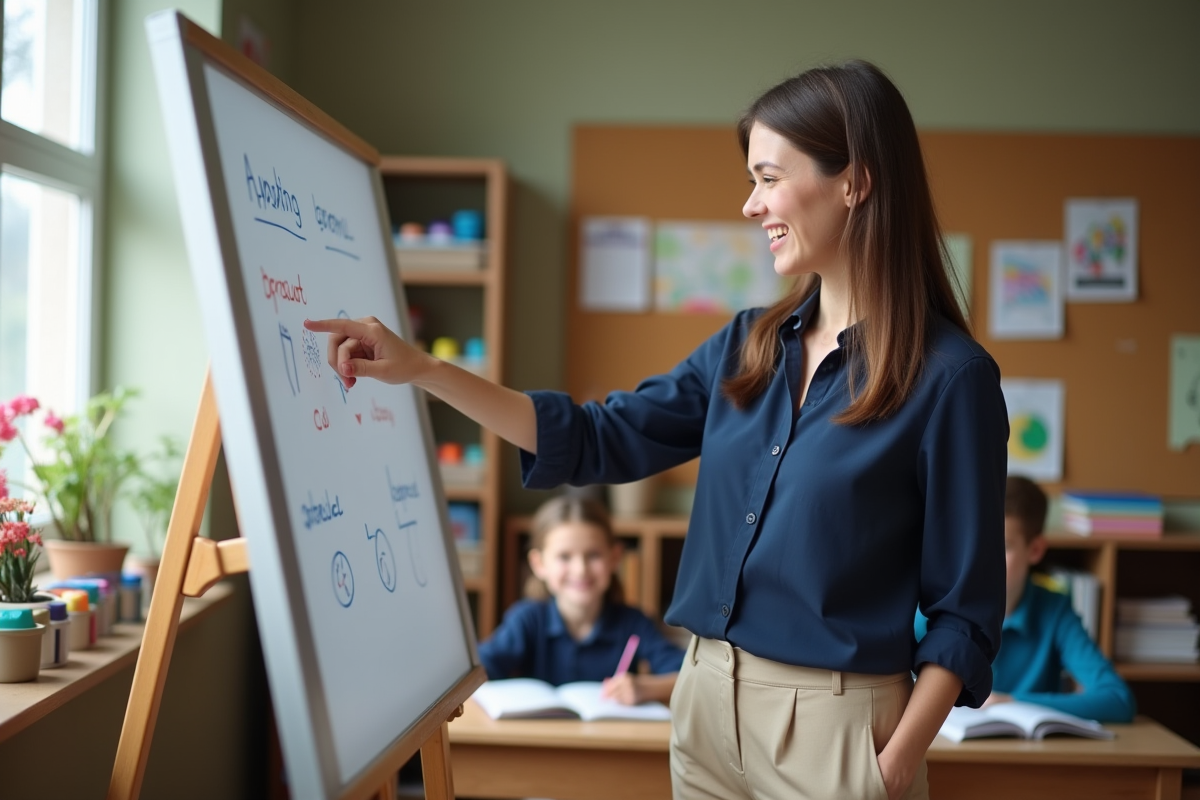
What tools and resources should be prioritized today to stimulate learning and support the evolution of teaching?
The range of available educational tools has expanded, allowing teachers to respond to the diversity of profiles and pathways. At the heart of current practices, pedagogical differentiation and personalized learning guide choices. Resources must be able to evolve, transform, and guarantee each student real access to content. An educational tool is no longer just a means of transmission: it becomes a space for experimentation, a space for exchanges, a lever for cooperation.
Advancements in educational artificial intelligence and adaptive learning enrich this dynamic. Learning platforms (LMS) enable individualized tracking, modular pathways, and tailored feedback for each student. This ability to generate formative feedback and adjust difficulty in real-time profoundly alters the relationship with assessment. Interactive quizzes, playful exercises, gamification: all means to enhance engagement. Digital mind maps, collaborative tools, or project management tools also provide autonomy and foster mutual assistance.
Here are the criteria that consistently arise for selecting effective tools:
- Accessibility: each resource must allow all students to fully engage.
- Inclusivity: the variety of pathways requires continuous adaptation.
- Assessment: measuring progress, adjusting devices, supporting each individual’s effort.
The refined management of pathways, the automation of certain tasks through digital means, and the personalization of content converge: they aim to support each student according to their pace while maintaining group dynamics. It is not so much the novelty of the tool that matters, but its ability to broaden the classroom’s horizon and give life to vibrant learning experiences.
Between tradition and innovation, the classroom today resembles a laboratory where the contours of tomorrow’s school are being drawn. The real challenge? To make each resource a springboard, not just a simple accessory.